
Latest criminalization, incarceration, and democracy updates - Jan 5, 2026

Top reads: As federal prisons run low on food and toilet paper, there’s an exodus of corrections officers signing up with ICE, reports Keri Blakinger for ProPublica; You can skip every other article on the horrifying direction that ICE is going and just read this thorough, sobering, and very well written piece by Radley Balko for The New Republic; North Carolina prisons are putting the squeeze on prisoners, extorting them for basic necessities; show this article to your friends who imagine that courts are fair and innocent people go free.
Media
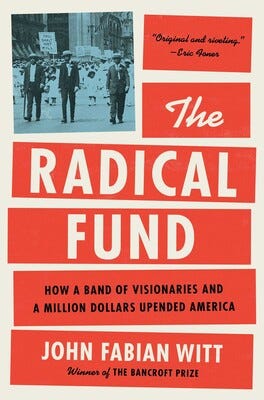
I’m reading The Radical Fund, by John Fabian Witt, and you should too! It tells the story of how a young man’s rejection of a $1million inheritance in 1922 enabled the creation of a fund that paid for some of the most iconic and foundational campaigns, organizations, and leaders in the pre civil rights era. The book looks like a doorstop but I promise it’s a page turner; every chapter uncovers the origins of the most consequential shifts in early modern America. Witt wrote an oped on America’s future that gives a taste of his style.
John Oliver covered the topic of felony murder, where a person can get a 1st degree murder sentence even if they didn’t kill or intend to kill anyone. It’s absolutely nuts and needs to end!
The Alabama Solution has been added to the short list for the Oscar best documentary category. As we come closer to the announcement of who the actual nominees are, it’s heartening to see the film get top billing on Variety’s list of notable 2025 documentaries. The film has drawn attention to extreme misconduct in the Alabama prison system, including by Officer Gadson, who’s been sued 26 times for brutal use of force.
Criminologist Jeff Asher interviewed Philadelphia DA Larry Krasner, who just won reelection for another term. They discussed Krasner’s commitment to data transparency, political narratives around crime, and the challenge of communicating a progressive message.
Aftershock: The Nicole Bell Story is a film about the police murder of Sean Bell, who they shot to death in his car the night before his wedding. The film describes the police coverup and the devastating impact on Sean’s fiancee and mother of his children, Nicole.
I was lucky enough to see the play Punch in London at the end of the year before it closed. The play follows the true story of a young man growing up rough and getting into a lot of trouble who throws a punch one night that kills a man. After serving prison time, he agrees to meet with the parents, and they end up working together to prevent others from dying this way. It’s definitely on the nose for my work, but it was also very well acted. The best thing for me was seeing the double standing ovation in the 100% packed Apollo theater at the end. Could England be ready for a serious push to prioritize prison reform and build alternative solutions?
If you’re interested to learn more about restorative justice from a participant perspective, the New Press has a book coming out for you: Restorative Justice Up Close.
Stuart Hall’s classic study on moral panics and the political uses of crime, Policing the Crisis, is about to be reissued. A timely moment! You can see a PDF here if you can’t wait till February.
Solutions and Wins
Governor Murphy of New Jersey reached a milestone of granting over 300 clemency requests before he leaves office, more than double the total of all NJ governors since 1994. One beneficiary was LaShawn Fitch.
A study in Nature finds that the presence of mental health ‘co-responders’, meaning people with mental health training who accompany police to mental health calls and use their expertise to stabilize the situation, results in substantially fewer people being put into involuntary mental health detention. This saves money, saves beds for people who really need them, and avoids the trauma of unnecessary mental health detentions.
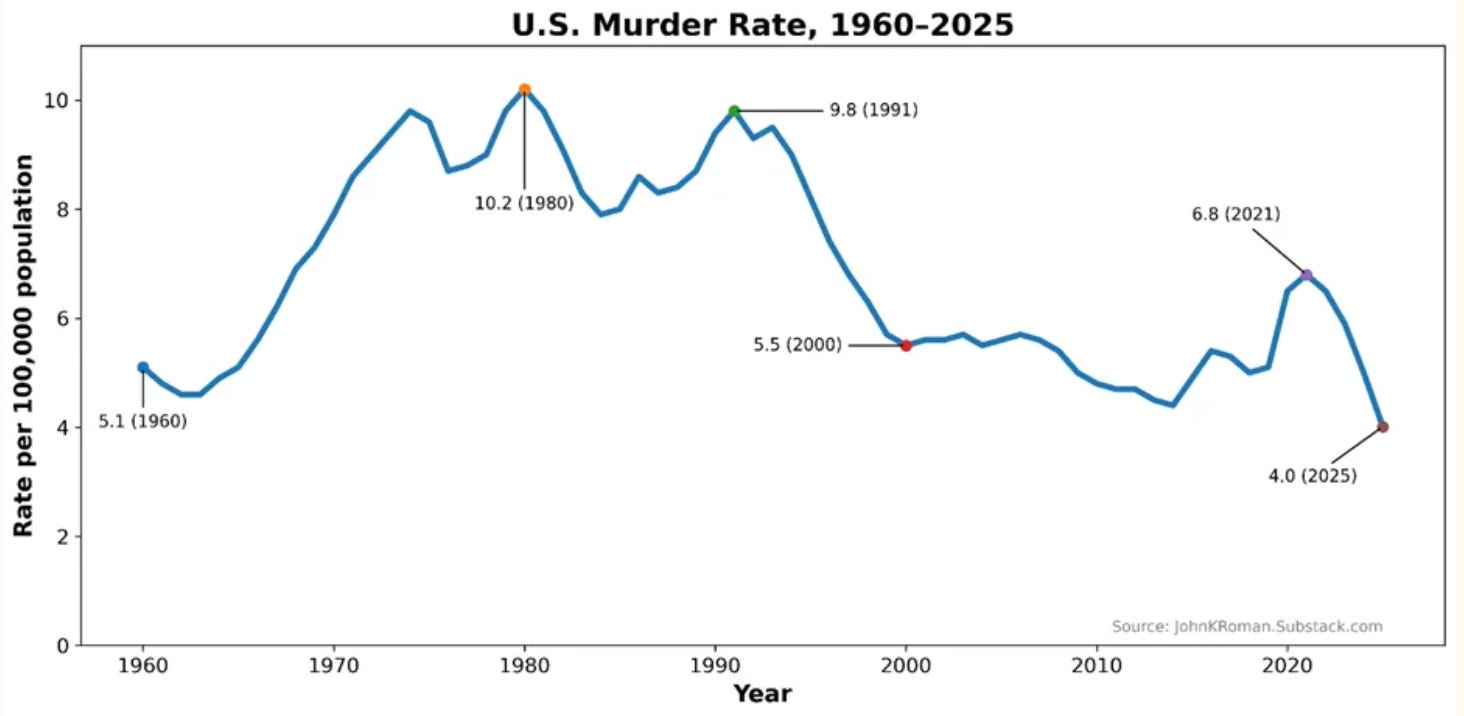
John Roman has a roundup on 2025 crime stats, documenting that the decline is enormous and persistent. The one downside here is that if any crime ticks up even a small amount, which has to happen at some point unless we are on track to total crime eradication, it will likely be picked up as much more of a story than the current decline.
Trump signed an order to expedite the process for marijuana rescheduling. President Biden pushed the issue as far as he could, but the wheels within agencies like the DEA were turning too slowly for it to get finalized in his term.
Philadelphia has achieved an unprecedented reduction in gun violence.
Commentary and Analysis
Check out Jonathan Ben-Menachem’s illuminating piece in The Nation laying out the context for Mamdani’s choice to retain Jessica Tisch as the police commissioner, notwithstanding serious misgivings on the left. All else aside, the left had not organized for any alternative, so that didn’t leave much of a choice. In a fascinating turn though, Klippenstein writes that Mamdani has ordered that Tisch now will report to his deputy rather than directly to him, breaking with past practice. A New York mayor starting the day some other way than meeting with the police commissioner? This could be a significant shift; we’ll have to see how it plays out.
Paul Engler writes about what social movements and social change strategists can learn from the “innovator’s dilemma,” described as follows: “what makes dominant [organizations] strong within the current market also makes them structurally resistant to what comes next.” Scrappy outsiders are the ones positioned to bring in new ideas, but there isn’t a consistent movement infrastructure to support them. Engler advocates that this be built.
Meanwhile, Mark Engler has done an engrossing and fascinating article about Myles Horton, one of the founders of the Highlander Center, a crucial meeting, training, and education hub for the labor movement and later the civil rights movement. Horton’s thinking about mobilization, polarisation, education, personal transformation, and bureaucracy are really relevant now.
Matthew Cavedon at the Cato Institute reminds us that we have to take into account the “unseen” success of people allowed to move on with their lives instead of being maximally punished for a crime. He cites a study from New York finding that eliminating cash requirements for bail actually cut the chances the person would be arrested for another crime by 12%. In other words, using the system less can reduce crime.
In his latest substack, Alec Karakatsanis tackles the false claim that criminal justice reform is ‘unpopular’ and therefore the sensible political line is to oppose or weaken it. On the contrary, data from Gallup and other major surveys show that large majorities favor spending less on police and more on social services including housing and health care. Crime survivors agree.
Reports, tools, and research
The Free Her Institute has a major new update on women’s incarceration.
The Marshall Project has been doing great work covering deaths in prisons and jails.
Scrutinize has drafted a plan for New York City to change how it picks judges.
Human Rights for Kids has a new report on the Trauma to Prison Pipeline.
More than 70% of people coming home from prison in south Florida get jobs through a temp agency within three years, where they get stuck with low wages and no benefits. Read more in the new Beyond the Bars report, The Temp Trap (discussed in article here).
Vera pulled together a bunch of explainer articles on various aspects of the criminal justice system into a single reference page.
A recent study finds that subjecting prospective hires to drug testing may cancel out the benefits of second-chance hiring reforms for people with records.
The National Association of Counties published a report highlighting services and programs across the country that “support community members living with a behavioral health condition or experiencing a behavioral health crisis.”
Prison Policy Initiative published its list of winnable reforms in 2026.
Politics and policy
Trump’s team is reportedly working on a big national crime bill with reform rollbacks. My sources in DC say that this is very inchoate and it’s too soon to tell if this really has momentum or not, and what it might actually contain.
The grinning founder of the surveillance firm Palantir wants to bring back public hangings.
Fantastic round up. Always appreciate reading these. Felony murder is indeed absurd (and now have to watch the Alabama doc!)
Thank you